Intermedia is an event-based programme that explores possibilities of counterpointing film, audio, visuals, and performative elements. We hope to invite practitioners interested in the refinement of their practice by challenging and exploring the possibilities in layering various mediums via architecture (metaverse), AR, VR, and live broadcasting.
19 posts
View by
"Political Animals" & "Scatter, Enclosure (The Herd Comes Down to Dream)", by Luca E. Lum
“Year after year I questioned the Brahmins, year after year questioned the holy Vedas. Perhaps, O Govinda, it would have been just as well, just as clever and just as salutary, had I put my questions to the rhinoceros bird or the chimpanzee.”
― Herman Hesse, Siddhartha (1922)
The assemblage of conservation is heterogeneous. In addition to lively human and animal bodies, it comprises nature reserves, fences, and guns; scientific instruments, maps, papers, and databases; legal designations, action plans, and market mechanisms; and films, websites, and online transfers, to give a few examples.
― Jamie Lorimer, Wildlife in the Anthropocene (2015)
*
Political Animals continues Luca's exploration into the animal and machine as figures that parse anticipation and catastrophe as part of her larger inquiry about nonhumanity, mediation, and time. For the presentation at h0thouse in August, she returns more specifically to the figure of the animal as encountered through animal media. This formal experiment combines elements of a lecture, poetry, and scenography, to look at the ways the figure of the animal make its appearances and appeals amid ecological, social, and political uncertainty and crisis. What is the animal as a genre of address? Pulling between contexts, histories, and points of view, she interrogates her own encounters with animals and animal media, ranging from archival material, talk show segments, and Tik Tok tutorials, curious about the ways animals form the medium, agent, and scale through which the social and political is metabolized and engineered. The presentation loosely plays with the idea of a media control room, making use of h0thouse's set up as a design studio and experimental play space.
The title plays off Aristotle's idea that man is by nature a "political animal"(zoon politikon) in his treatise Politics, by dint of living in a society with others.
The presentation contains elements of Luca’s ongoing project Scatter, Enclosure (The Herd Comes Down to Dream), which looks at the the history of extirpation (localised extinction) and rewilding of the Milu deer (Père David's deer) in China. What began as a way to re-enter writing after the death of her father, has expanded to consider the notions of herd and ecological assemblages of memory and mourning, how death impacts language, and how the forms of an animal's range and enclosure form not only spatial values but temporal ones. Early writing from this is featured in Making Kin: Animals (cthulhu books, the Institute for Postnatural Studies, Madrid).
The lecture performance "Political Animals" takes place on 21 August 2026, followed by a brief discussion with the artist.
A reading of passages from "Scatter, Enclosure (The Herd Comes Down to Dream)" will take place during the Open Studios, 22 August 2026.
The entries below provide a glimpse into her recent work and some influences behind her research process.
***
This presentation is supported by a grant from the National Arts Council Singapore.
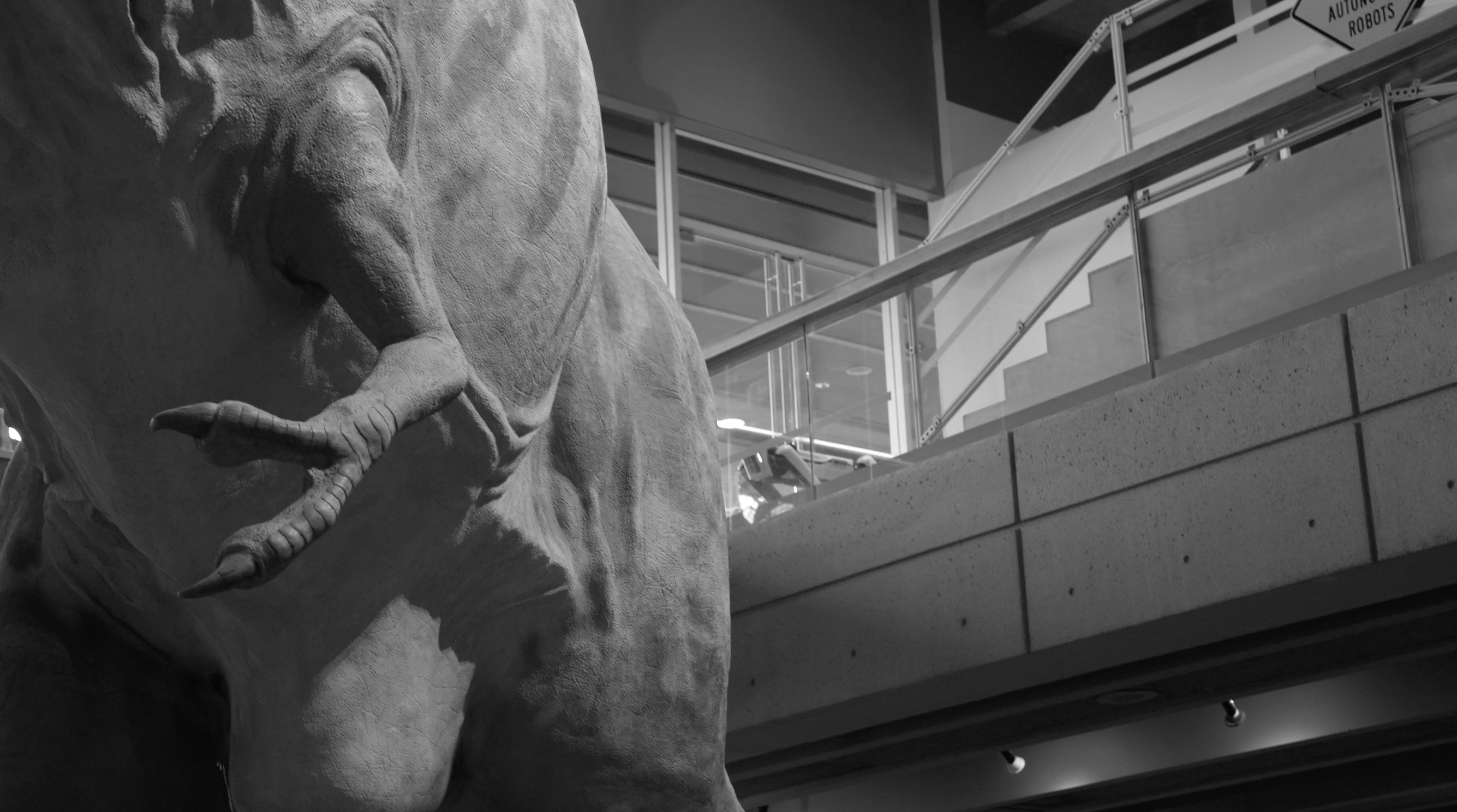
Still from Ghostless (Notation 3.), 2025. Luca E. Lum. Single channel video with stereo sound. 11 mins 30 seconds.
This still from Luca's moving image work captures Spot, Boston Dynamic's biomimetic robot peeking over at the T-Rex diorama below while making its programmed loop around its enclosure at the Boston Museum of Science. The work incorporates dioramas from Carl Ackeley's Hall of African Mammals in the American Museum of Natural History and a soundtrack involving a discussion with Celestis Memorial Space Flights on the space "burial" of her father's ashes, to explore the architectures and apparatuses —particularly the gazes of the animal and the animal-machine— that animate scenes of loss and anticipation. The metallic hum that runs through the piece is from a recording of a quantum computing refrigerator from Harvard University.
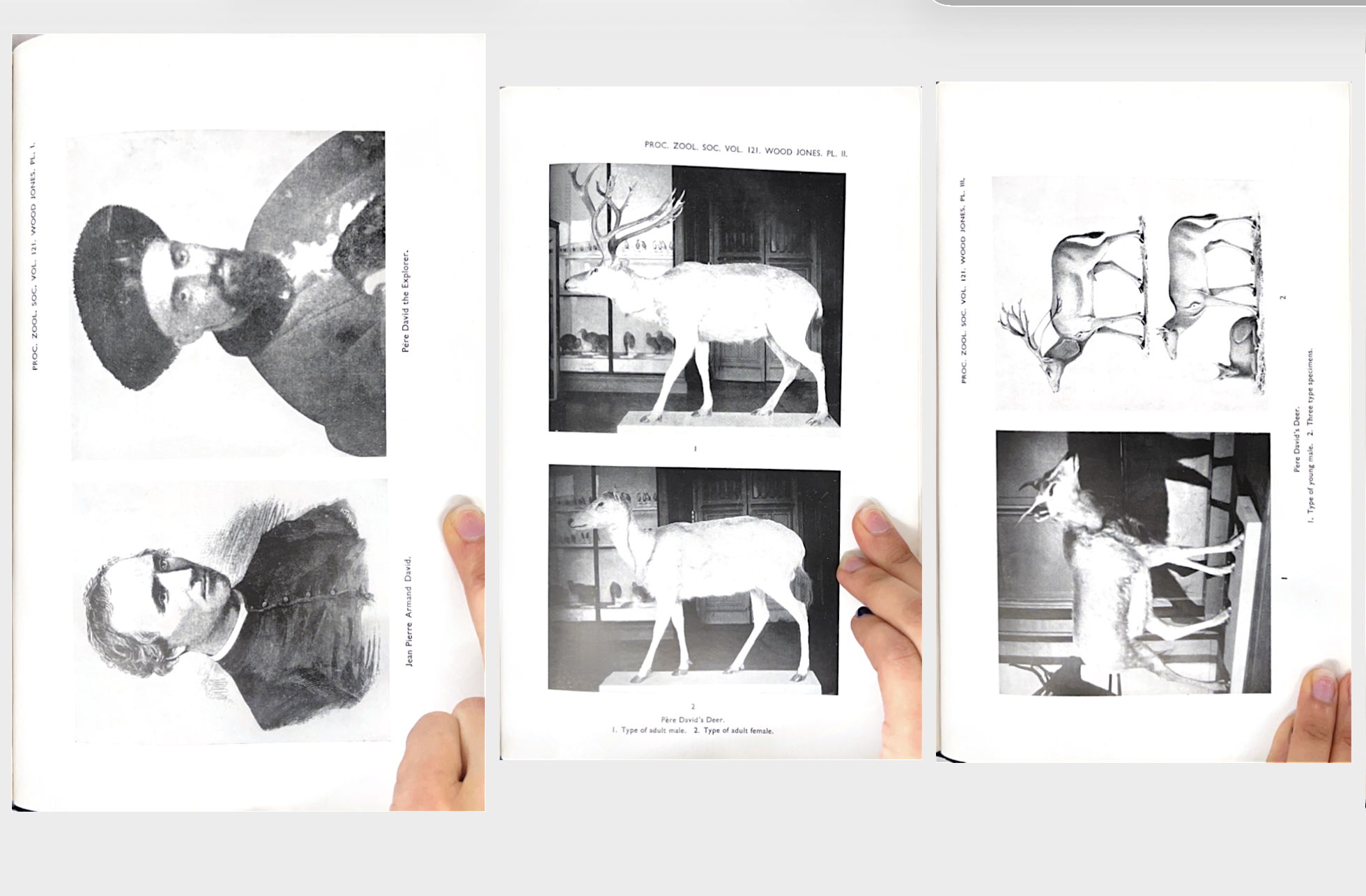
Research material for "Scatter, Enclosure (The Herd Comes Down to Dream", depicting preserved specimens of the Milu deer and portraits of Père David, pulled from the Wellcome Collection, London, 2023
The Chinese Milu deer were exported out of China by the French priest Père David before they were killed during the tumult of the Boxer Rebellion. Several exist as specimens in surgeon John Hunter's (1728-1793) collection. Comparative zoology played a large role in understanding anatomy and the study of modern surgery.
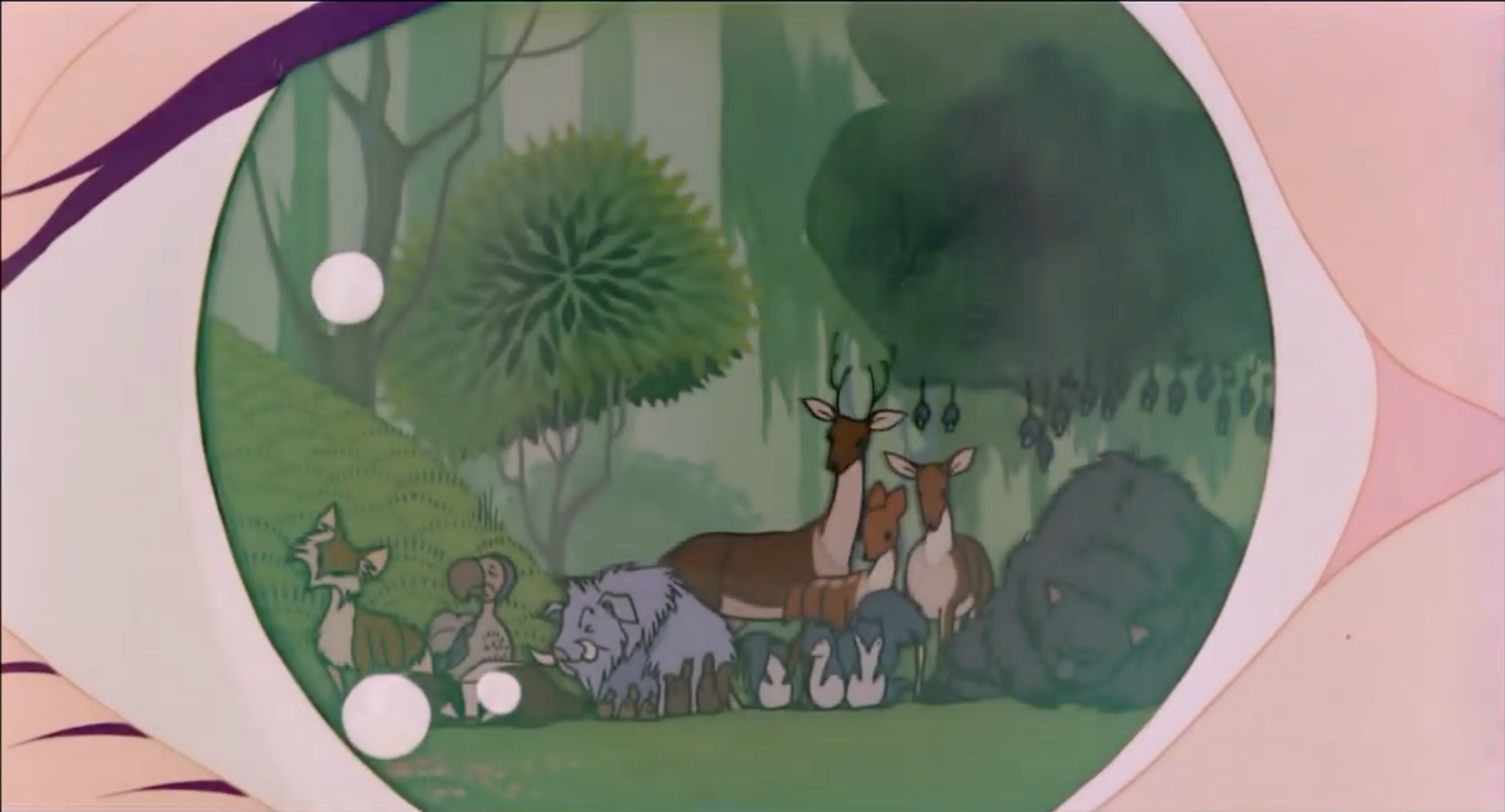
Still from The Last Unicorn (1982), Arthur Rankin Jr and Jules Bass, based off the novel by Peter S. Beagle (1968)
Lady Amalthea, voiced by American actress Mia Farrow, has been transformed into human guise for her safekeeping. As part of her disguise, she has forgotten her own identity as the last unicorn. In the still from this scene, she is confronted by King Haggard, voiced by the late American actor Christopher Lee, whose inner emptiness is the cause of the extinction of the unicorns. Demanding who she is (because, I think, he knows she is the last unicorn), Haggard cannot see his own reflection in Lady Amalthea's eyes; he is confronted instead by a glade of woodland animals.
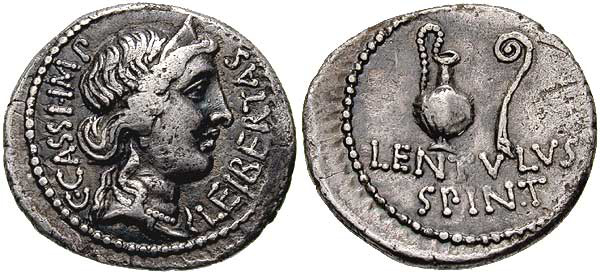
(Above) Roman coin; to the left, the underside depicts a crooked wand called a "lituus", used in augury (bird divination) Can we think of the ritual of augury as a proto-cybernetic system, where the biological signs of animals are captured by architectural hardware (templus and lituus) to generate legal and political authority? The fact that the lituus appears among Roman coins indicates its material and symbolic currency in ancient Roman statecraft.
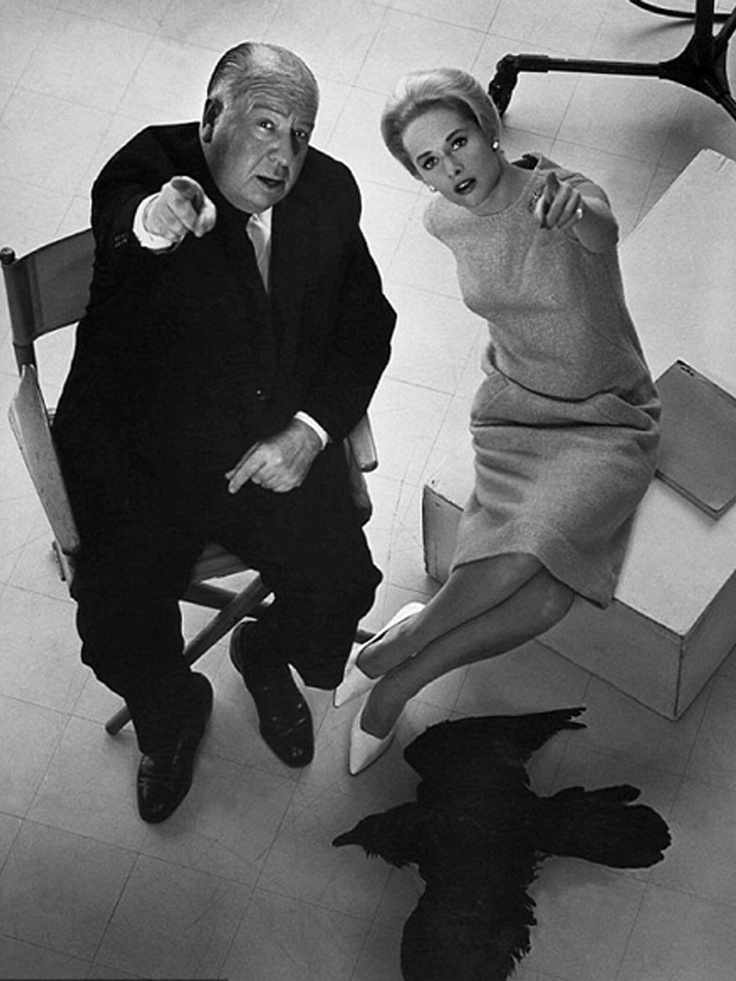
(Right)Alfred Hitchcock, Tippi Hedren, prop crow, behind the scenes of The Birds (1963), a film based off the 1952 novel by Daphne du Maurier
(Below) scenes from The Birds (1953), by Alfred Hitchcock
The thrill and horror of The Birds arrives in the way the animals are shot as sudden, unpredictable movement – one moment still and possibly tame, a dormant ferality, and the next a violent swarm. In both circumstances unreadable and other. They will even risk demise.
“Perhaps, thought Nat, munching his pasty by the cliff’s edge, a message comes to the birds in autumn, like a warning. Winter is coming. Many of them perish. And like people who, apprehensive of death before their time, drive themselves to work or folly, the birds do likewise.”
– The Birds (1952), Daphne du Maurier
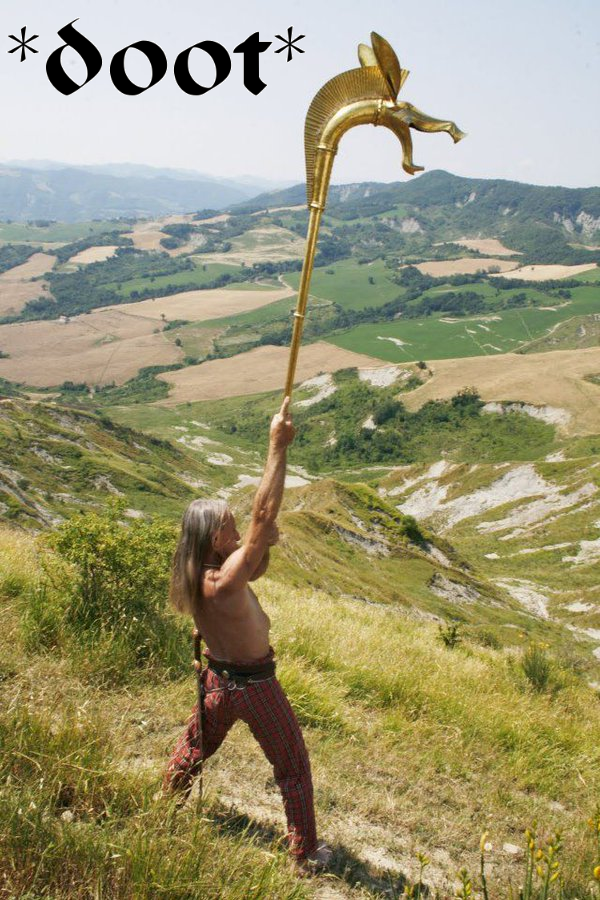
The Carnyx is a Celtic horn thought to have developed from the Bronze Age Etruscan-Roman Lituus through cultural contact, usually topped with an animal
Subcultures dedicated to reconstruction of ancient instruments and weaponry are particularly fascinated by these instruments, which were used to sound and gather armies in battle. The Lituus was more ceremonial and ritual in use.
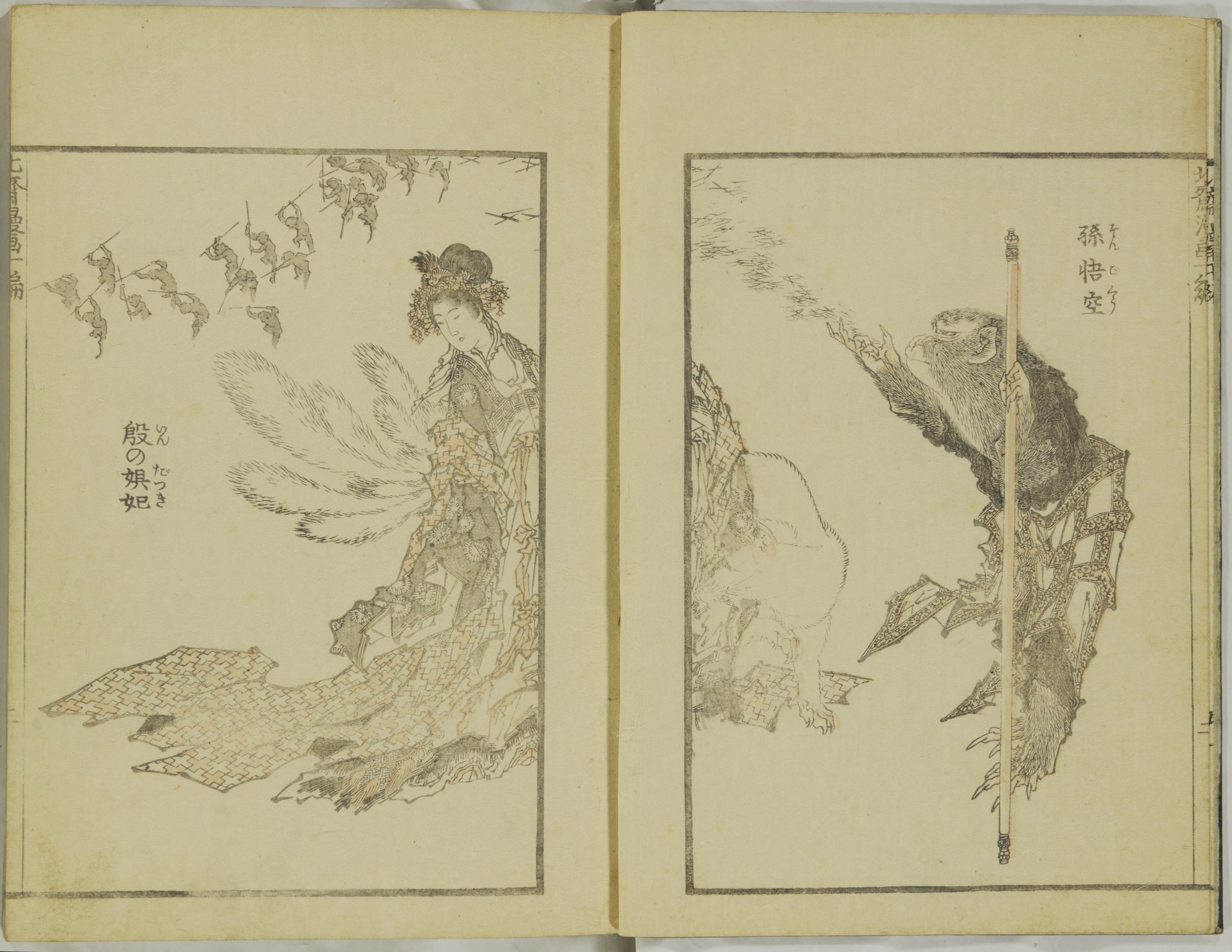
An illustration of “Daki (Daji) of the Shang Dynasty and Sun Wukong” from the Hokusai manga 北斎漫画 (Random Drawings by Hokusai) . Vol. 10 from a series of fifteen volumes. Woodblock-printed. 1819. British Museum.
A depiction of two tricksters: Daki (Daji), a concubine of the Shang emperor, characterised as a sly, shape-shifting fox demon (kitsune yokai), and Sun Wukong, from Journey to the West (1592). In Daji/Daji's many incarnations, her sexual prowess is linked to violent deaths of the ruling emperor, her vixenhood being a matter of transgressive descent and the shattering of imperial rule.
"The Ming dynasty novel Zhaoyang qushi continues where the story of Daji left off, but takes a very different tone. The fox spirit who had become Daji is not content in the heavens after her taste of life on earth, and she sets off to a secluded cave to establish her own fox kingdom, an undertaking reminiscent of Sun Wukong's kingdom in Xiyou ji (Journey to the West), which provides a model for using a supernatural animal as a protagonist. Her defeat of a swallow spirit in sexual battle leads to a war between their minions. Finally a divinity banishes them both to the moral world. The swallow is rebron Zhao Feiyan and the vixen as Zhao Hede, both of whom become concubines of the emporer Han Chengdi. [...]True to her nature as a reincarnation of Daji, Hede is the more violent of the two, she brings about the death of the emperor as well as her rivals." (Huntington, Rania. Alien Kind: Foxes and Late Imperial Chinese Narrative. Harvard East Asian Monographs. 2003)
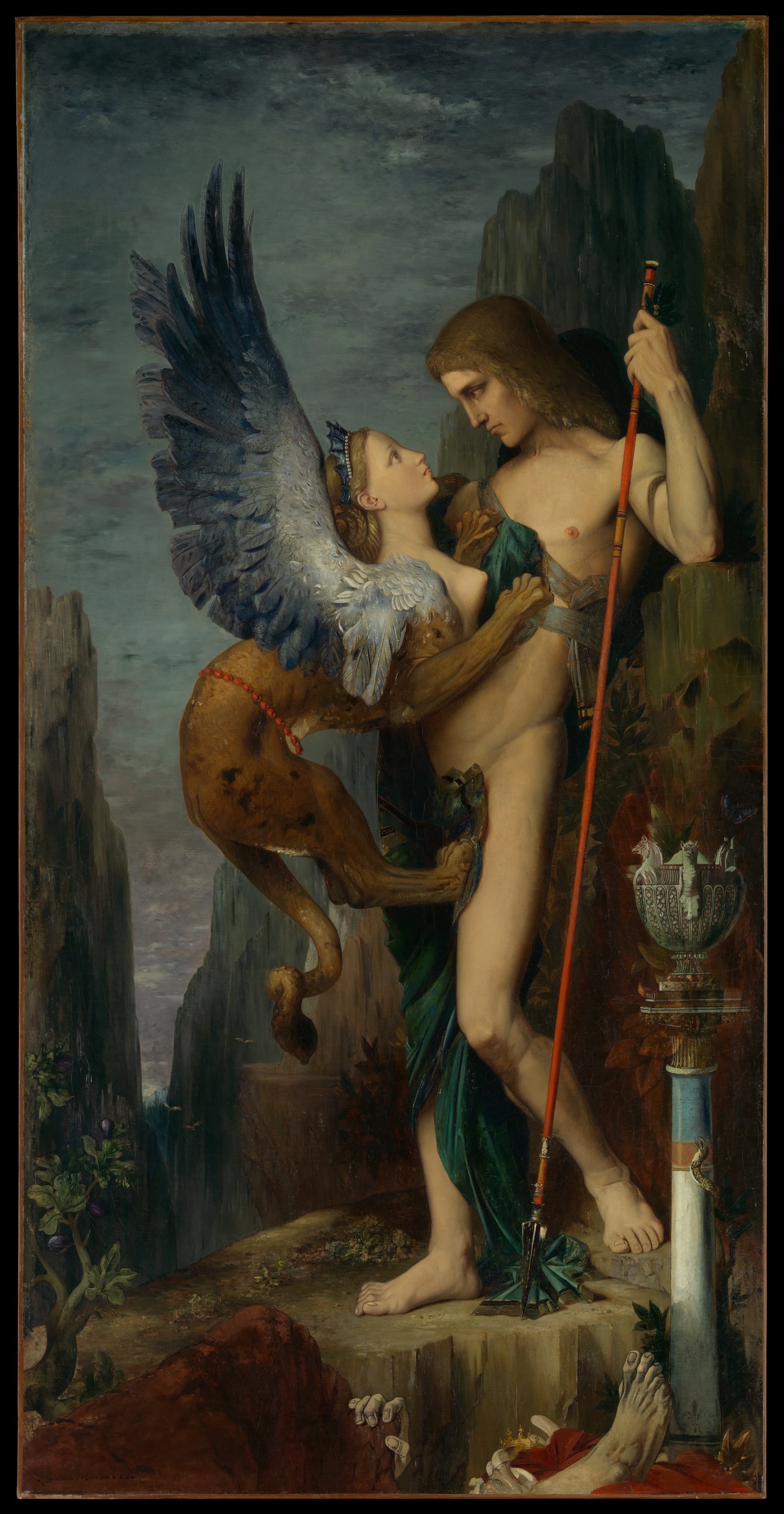
Oedipus and the Sphinx, 1864 oil on canvas painting by Gustave Moreau
The sphinx is a winged mythological creature with the hind parts of a lion, an icon of death and disaster. In Sophocles' Greek tragedy, Oedipus Rex, first performed in 429 BC, the prince Oedipus is prophesized by the fates to kill his father and couple with his mother, causing the downfall of the kingdom of Thebes. As a means to allay the fates, he is abandoned in the wilds and adopted by a sherpherd. When the sphinx terrorizes the city of Thebes, Oedipus rises to the challenge. Answering the sphinx's riddle, he defeats the sphinx, kills his father, and marries his mother. As a play where the motifs of blindness, misrecognition, riddling, prophecy, and strangulation abound, it became the basis for Luca's 2021 video work, SPHINXES (Infernals), where the sphinx's role as living images, guardians of thresholds, riddlers and stranglers, became a way for her to consider the death and life drives of contemporary image regimes.
Au Hasard Balthazar (Balthazar, at Random), Robert Bresson (1966)
In Bresson's austere pastorals which include Mouchette (1967), and Diary of a Country Priest (1951), the natural world is a site of quiet apocalyptism. In Au Hasard Balthazar, Balthazar, a donkey, is the central figure around which the relational dramas and themes revolve and clarify themselves. Subject to the whims of fate, Balthazar changes ownership several times, and is eventually killed by a border guard while being used to smuggle black market goods over the Pyrenees border between France and Spain. Through the course of the film, he becomes a sort of gathering site of love, jealousy, ridicule, exploitation, abuse, death, and eventually, even a kind of martyrdom. Observed as a quasi-religious figure of grace and tolerance, his fate parallels the other human figures of exploitated innocence.
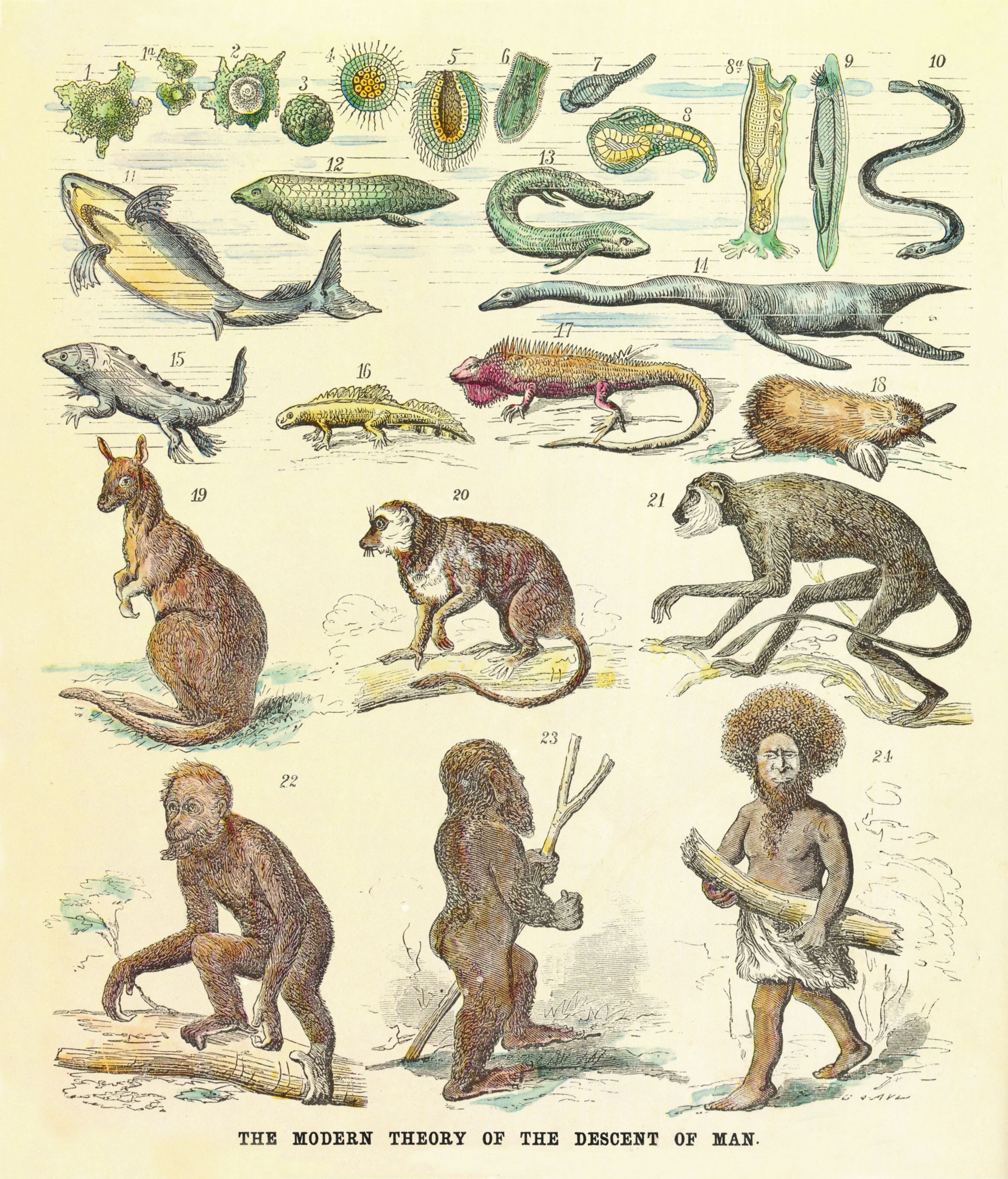
The human pedigree recapitulating its phylogeny back to amoeba shown as a reinterpreted chain of being with living and fossil animals. From a critique of Ernst Haeckel's theories, 1873. Source:
G Avery's opinion of The modern theory of the descent of man, by Ernst Haeckel, published in Anthropogenie oder Entwicklungsgeschichte des Menschen (The Evolution of Man),1874. The figure show the human pedigree as a Great Chain of Being, illustrated by modern and fossil species. Hand-coloured print
Legend: 1 Amoeba 1a Asexual reproduction (amoeba dividing) 2 Sexual reproduction (cell with spore) 3 Multi-cellular organism (early embryonic stage) 4 Muliticellular organism with three germ layers (blastula) 5 Organism with primitive mouth (gastrula) 6 Planaria 7 Worm (leech) 8 Primitive chordate (tunicate larva) 8a Adult tunicate 9 Lancelet 10 Jawless fish (lamprey) 11 Cartilaginous fishes (shark) 12 Australian lungfish 13 South American lungfish 14 Aquatic reptile (plesiosaur) 15 Aquatic amphibian (Axolotl) 16 Modern amphibian (newt) 17 Reptile (iguana) 18 Monotreme (platypus) 19 Marsupial (kangaroo) 20 Prosimian (lemur) 21 Monkey (langur) 22 Ape (orangutan) 23 Ape-man (Pithecanthropus) 24 Modern human (a Papuan).
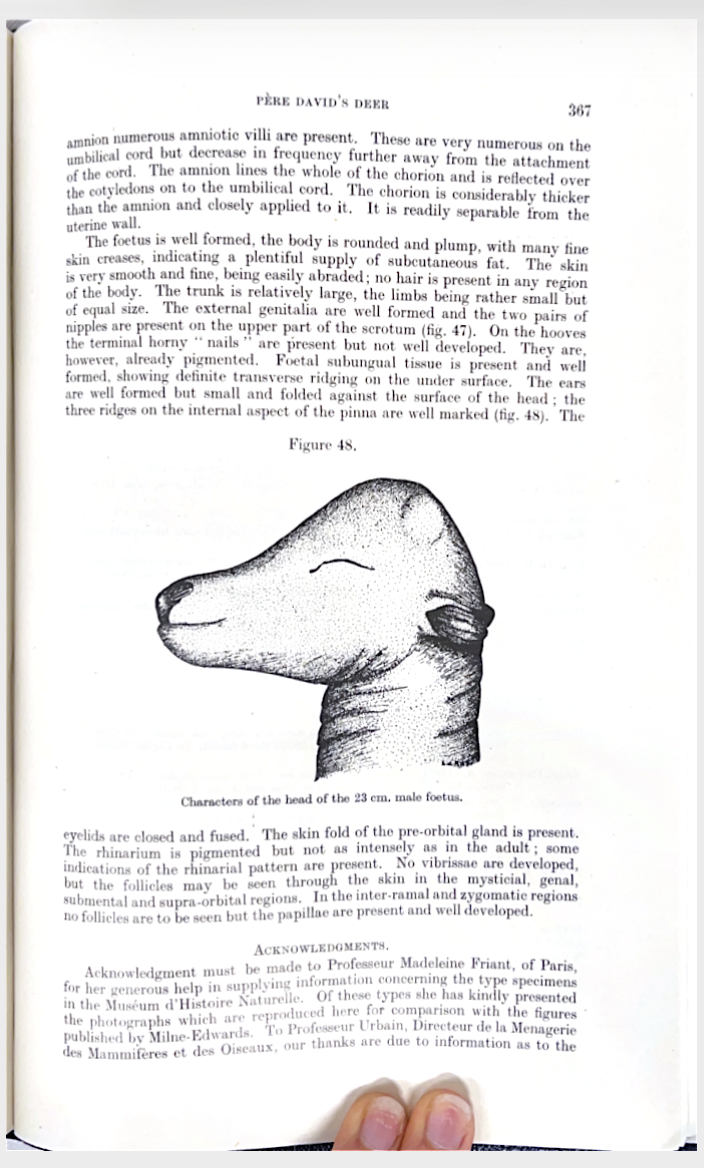
Phone scan of a page on a preserved speciment of the Milu deer from Jessie Dobson's The Hunter speciments at Kew Observatory, surgical journal on John Hunter's comparative zoology collection. Wellcome Collection stacks.
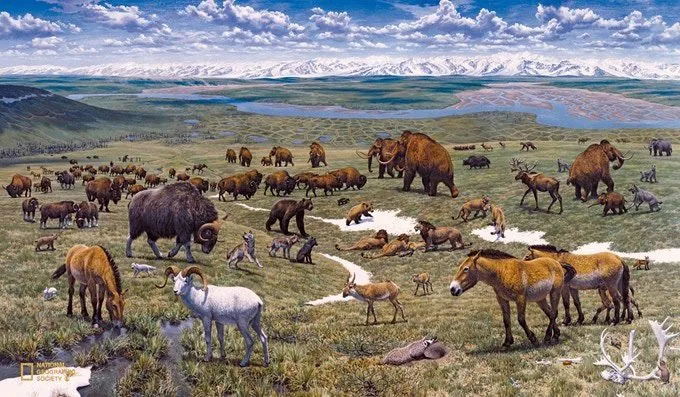
An artist rendering of Pleistocene Park, Sakha Republic, Siberia, Russia. Operational since 1988.
An effort to rehabilitate the ice-age grassland steppe ecology through a rewilding of both flora and fauna. Pleistocene Park is one of many global efforts, which include the more splashy, head-lining bio-engineering attempts by Colossal Biosciences to resurrect extinct species like the dire wolf, to re-instantiate revival in a way that can host and continue life, amid climate collapse and eschatological anxieties. Beth Shapiro, Colossal’s chief science officer, is quoted in the Time article as saying: “We [humanity] are an evolutionary force at this point,” [...] “We are deciding what the future of these species will be.” Every other day in a lab somewhere newness and oldness blunts its own time ... wheat germ DNA is being extracted and spliced, a meadow forgets, a book is written, a bird becomes functionally extinct, a grey wolf returns to California , what really is the beginning or end of a thing?
Meriem Bennani and Orian Barki's pandemic offering, 2 LIZARDS (2020), first uploaded onto instagram, features anthropomorphic geckos among a cast of other animals in a world turned anomalous by global illness. Touchingly funny, it elicits relief and a weird hopefulness. Is it because when we speak through animals we forget ourselves a little? An allegory needs enough of a distancing mechanism for it to work. Or is it because animated animals remind us of childhood fables, which means a time when life and world has a clear lesson? Their latest film, BOUCHRA (2025), also uses anthropomorphic animals to tell a story about diaspora, creativity, family, and queer love.

Luca E. Lum: artist and writer
Luca E. Lum is an artist and writer attuned to occluded dispositions of time, body, and affect. Working with moving image, lens-based media, writing, installation, drawing, performance, and collaborative situations, her work attends to the affective grounds upon which our realities and ideologies are inscribed. Her inquiry into nonhumanity, mediation, subjectivity and eschatology in our technopolitical worlds informs her foray into what she calls "ghostless time".
She holds an MS in Art, Culture, and Technology from the Massachusetts Institute of Technology and a BA (Hons) in English Literature from the National University of Singapore.
Luca's work has been supported by the Massachusetts Institute of Technology (MA, USA), the Delfina Foundation (LDN, UK), the NTU Center for Contemporary Art residency (SG), Materia Abierta (CDMX, MX), A. Farm Saigon, under the auspices of Sàn Art (HCMC, VT), the Cemeti Institute for Art and Society (with soft/WALL/studs) (JOG, ID), Pa Rang Cafe & Art Stay (CM, TH) and the Triple Canopy Publication Intensive (NYC, USA).
She was a co-founder of soft/WALL/studs (2016-2021), a collaboratively held space, shared library, and series of actions in Singapore that experimented with renewed situations of discursivity, agency, autonomy, and communality.
Notes